
10 Fascinating Psychology Facts That Explain How Your Mind Works
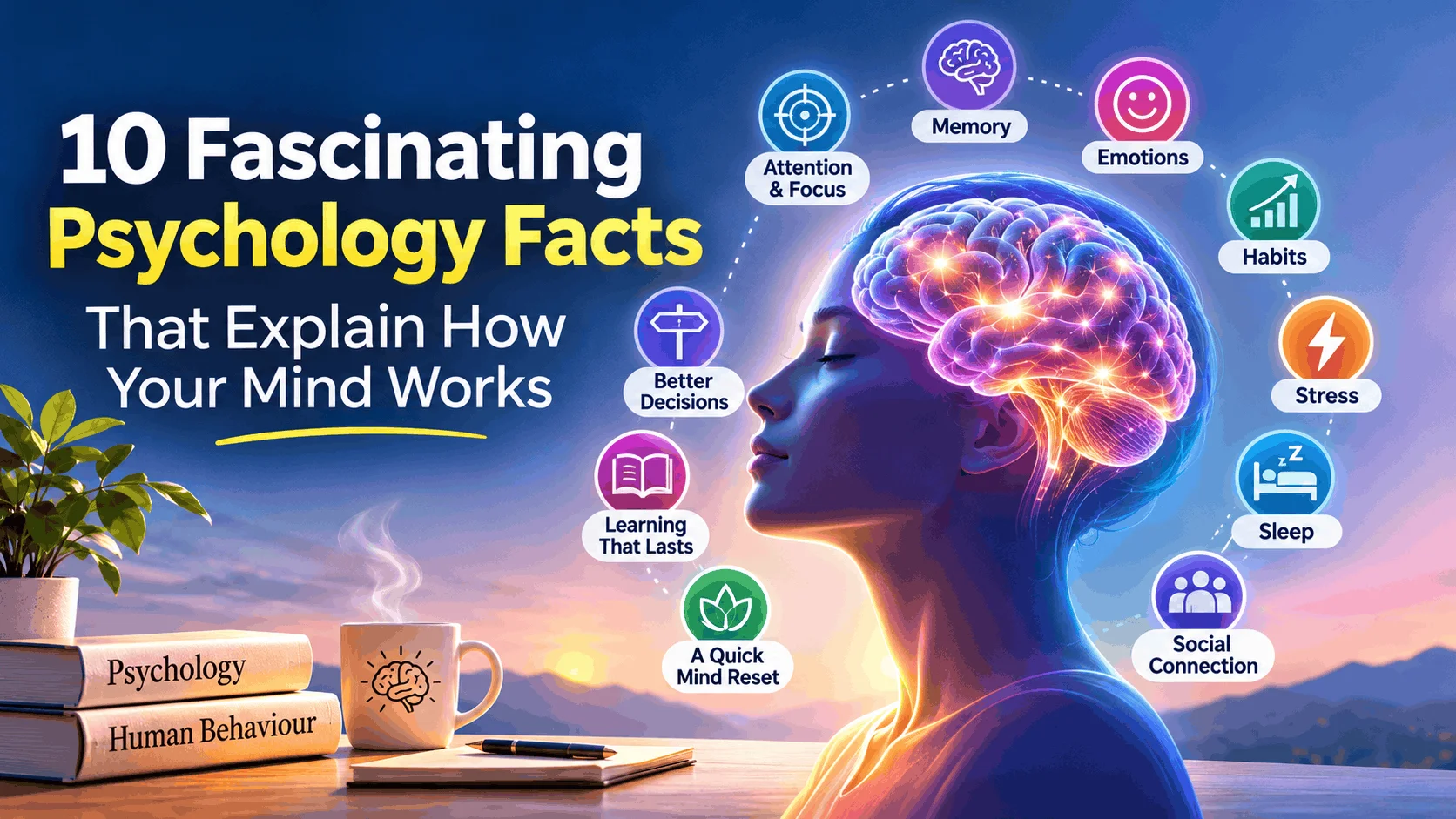
10 Fascinating Psychology Facts That Explain How Your Mind Works
Your brain makes thousands of small decisions every day without you even noticing. Psychology is the science behind those decisions: why you remember certain things and forget others, why you feel nervous before speaking in public, and why a small habit can be surprisingly difficult to break.
The following psychology facts are backed by decades of research. Each one reveals something interesting about how your mind works and offers practical lessons you can apply to everyday life.
1. Your Brain Cannot Truly Multitask
One of the most famous findings in psychology concerns attention.
Your brain cannot truly multitask when performing two demanding activities. When you think you are doing two things simultaneously, your brain is actually switching back and forth between tasks very quickly.
Each switch costs a little time and accuracy.
Research by Ophir, Nass, and Wagner (2009) examined cognitive control in media multitaskers and highlighted the challenges associated with managing multiple streams of information.
This explains why texting while driving is dangerous and why studying with the television on can feel harder than it should.
What this means for you: Instead of dividing your attention between several demanding activities, focus on one important task at a time. You may accomplish more with less mental effort.
2. Memory Is Not a Recording
Memory works more like a story you retell than a video you replay.
Every time you remember something, your brain reconstructs that experience. Small details can change without you realising it.
Research by Loftus and Palmer (1974) demonstrated how the wording of questions could influence people’s memories of an event. Schacter (1999) also explored how memory can be distorted and reconstructed.
This explains why two people can remember the same event very differently, even when both are being completely honest.
Fortunately, there are ways to strengthen memory:
- Write things down: Recording information helps reinforce what you learn.
- Repeat information aloud: Repetition can help strengthen memory.
- Test yourself: Trying to recall information without looking at your notes helps improve long-term retention.
Research by Roediger and Butler (2011) highlights the importance of retrieval practice in long-term learning.
What this means for you: Don’t rely entirely on your memory. Write down important information and regularly practise recalling what you have learned.
3. Your Emotions Are More Than Just Feelings
Feelings are not simply reactions. They can also provide information about what is happening around you and how you interpret a situation.
For example, anxiety before an important examination may signal that something matters deeply to you.
Research by Schwarz and Clore (1983) explored how emotional states influence people’s judgments and perceptions of well-being.
Instead of automatically fighting uncomfortable emotions, learning to recognise and understand them can help you respond more thoughtfully.
Some practical techniques include:
- Taking slow, controlled breaths.
- Identifying and naming what you are feeling.
- Breaking overwhelming tasks into smaller steps.
- Recognising what is triggering your emotional response.
What this means for you: Your emotions deserve attention, not judgment. Learning to understand them can help you make more thoughtful decisions.
4. Why Small Changes Work Better Than Big Resolutions
Why do so many New Year’s resolutions fail?
One reason is that dramatic lifestyle changes often demand too much effort at once.
Psychology research suggests that small, specific habits are more likely to become part of your daily routine than major changes that depend entirely on motivation.
For example:
- Read for five minutes every day.
- Take a short walk after lunch.
- Spend ten minutes learning something new.
- Practise gratitude before going to sleep.
A study by Lally et al. (2010) examined how habits develop through repetition in everyday life.
The findings highlight an important lesson: habits take time to develop, and consistency matters.
Your brain builds habits through repetition, not willpower alone.
What this means for you: You don’t need to transform your entire life in one day. Start with one small action and repeat it consistently.
5. Stress Is a Signal, Not an Enemy
Stress gets a bad reputation, but in small doses, it can be useful.
A deadline that makes your heart beat faster, for example, can mobilise your body’s energy to meet a challenge.
Research by McEwen (2007) explains the central role of the brain in the body’s stress response and adaptation.
Interestingly, people can sometimes improve their responses to stressful situations by interpreting physical signs of stress as excitement rather than fear. This was explored by Jamieson, Nock, and Mendes (2012).
However, the problem begins when stress never switches off.
Weeks of poor sleep, constant worry and insufficient recovery time can affect concentration, mood and even immune function.
Some practical ways to manage stress include:
- Maintaining a regular sleep schedule.
- Getting daily physical activity.
- Spending time with people you trust.
- Identifying what is actually causing the pressure.
- Writing down your worries instead of repeatedly thinking about them.
Writing about a concern can help you organise your thoughts and make a difficult situation feel more manageable.
What this means for you: Stress is not always something you need to eliminate. Learn to recognise it, understand its source and give yourself enough time to recover.
6. Sleep Helps Your Brain Remember What You Learn
Memory doesn’t stop developing when you close your books. An important part of the learning process happens while you sleep.
During sleep, your brain processes experiences and helps consolidate important information into long-term memory.
Diekelmann and Born (2010) examined the relationship between sleep and memory, explaining how sleep supports the consolidation of newly acquired information.
This is one reason why getting a good night’s sleep after studying can be more beneficial than staying awake for another hour of cramming.
Insufficient sleep can:
- Reduce attention and concentration.
- Make emotional regulation more difficult.
- Affect decision-making.
- Interfere with memory formation.
- Reduce your ability to solve problems effectively.
Sleep also plays an important role in learning new skills, whether you are a student preparing for an examination or an adult learning something new at work.
What this means for you: Treat sleep as an essential part of learning and productivity, not as wasted time. Your brain needs rest to process what you experience throughout the day.
7. Other People Shape Your Mind
Humans are social beings, and our relationships play an important role in psychological well-being.
Research by Cacioppo and Patrick (2008) explores how loneliness relates to the fundamental human need for social connection.
A meta-analysis by Holt-Lunstad, Smith, and Layton (2010) also found an association between social relationships and mortality risk.
You don’t need hundreds of friends to experience the benefits of meaningful relationships. A few close connections and regular friendly interactions can make a difference.
Consider some simple everyday activities:
- Having a meaningful conversation with a friend.
- Spending quality time with family.
- Talking to a neighbour.
- Sharing a joke with a colleague.
- Listening carefully when someone talks about their experiences.
Conversation itself can exercise your mind. Listening, remembering details and responding thoughtfully all require attention and mental effort.
Even brief, warm interactions can contribute to a more positive everyday experience.
What this means for you: Don’t underestimate the power of human connection. Sometimes, a simple conversation with someone you trust can make a difficult day feel lighter.
8. How to Make Better Decisions
Good decisions rarely come from thinking harder. They often come from thinking in the right order.
Your brain uses mental shortcuts to make everyday decisions quickly. Most of these shortcuts are helpful, but they can also lead to predictable mistakes.
For example:
- Favouring the first option you hear.
- Giving too much importance to dramatic experiences.
- Making decisions based on temporary emotions.
- Overthinking simple choices.
Tversky and Kahneman (1974) explored how mental shortcuts, known as heuristics, influence human judgment and decision-making.
A simple approach can help you make better decisions:
- Understand what you actually want: Identify your main goal before considering the options.
- Explore your choices: Look at the available options objectively.
- Consider the consequences: Think about what might happen after each decision.
- Give yourself time: Avoid rushing important decisions when emotionally overwhelmed.
- Learn from mistakes: Treat unsuccessful decisions as opportunities to understand what went wrong.
For smaller decisions, setting a time limit can prevent unnecessary overthinking.
For bigger decisions, taking a break and looking at the situation again with a fresh mind can be helpful.
What this means for you: Every decision is an opportunity to learn. Don’t focus only on whether you made the right choice. Also focus on what the experience teaches you.
9. The Secret to Learning That Lasts
One of the most reliable ways to learn something is also one of the least comfortable: testing yourself.
Reading the same page three times may feel productive, but it doesn’t necessarily mean you have understood or remembered the information.
Try a different approach:
- Read a topic carefully.
- Close your book or notes.
- Try to explain what you remember.
- Identify the information you missed.
- Repeat the process after some time.
This technique is known as active recall.
Another useful approach is spaced repetition. Instead of studying something for 30 minutes in one sitting, divide your practice into shorter sessions across different days.
A review by Cepeda et al. (2006) examined distributed practice and its effectiveness in improving verbal recall.
Teaching someone else is another useful technique. Explaining an idea in your own words helps you identify gaps in your understanding.
None of these methods requires special equipment or exceptional talent.
What this means for you: Don’t just read information repeatedly. Challenge yourself to remember it, explain it and apply it.
10. The Two-Minute Reset: A Simple Way to Calm Your Mind
When a bad mood or racing thoughts take over, a simple grounding exercise may help you regain a sense of control.
Try this two-minute reset:
Step 1: Pause
Stop what you are doing and place both feet comfortably on the floor.
Step 2: Breathe Slowly
Take five slow breaths. Try breathing out slightly longer than you breathe in.
Step 3: Notice Your Surroundings
Identify:
- Three things you can see.
- Two things you can hear.
- One thing you can physically feel.
This simple exercise combines slow breathing with sensory awareness.
Research by Ma et al. (2017) examined the effects of diaphragmatic breathing on attention, negative emotions and stress in healthy adults.
Slow breathing may help settle your body’s stress response, while focusing on your surroundings can bring your attention away from overwhelming thoughts and back to the present moment.
It won’t automatically solve the problem that upset you, but it may help you approach the situation with a calmer mind.
What this means for you: You don’t always have to react immediately. Sometimes, taking two minutes to pause can help you choose a better response.
Final Thoughts: Understanding Your Mind Is the First Step Towards Growth
Psychology helps us understand ourselves a little better.
Why do we overthink? Why do certain memories stay with us? Why is changing a habit so difficult? Why do some days feel emotionally heavier than others?
The answers often begin with understanding how our brains work.
Small changes in the way we think, behave and interact with others can gradually improve our everyday experiences.
You don’t have to get everything right. You simply need to remain curious, keep learning and give yourself room to grow.
Remember: Your mental well-being matters, and taking care of your mind is just as important as taking care of your body.
If you enjoy learning about psychology, human behaviour and mental well-being, explore more easy-to-understand insights at Known Psychology.
References and Further Reading
The following academic publications and books support the research discussed in this article.
- Cacioppo, J. T., & Patrick, W. (2008). Loneliness: Human Nature and the Need for Social Connection. W. W. Norton.
- Cepeda, N. J., Pashler, H., Vul, E., Wixted, J. T., & Rohrer, D. (2006). Distributed practice in verbal recall tasks: A review and quantitative synthesis. Psychological Bulletin, 132(3), 354–380.
- Diekelmann, S., & Born, J. (2010). The memory function of sleep. Nature Reviews Neuroscience, 11(2), 114–126.
- Holt-Lunstad, J., Smith, T. B., & Layton, J. B. (2010). Social relationships and mortality risk: A meta-analytic review. PLoS Medicine, 7(7), e1000316.
- Jamieson, J. P., Nock, M. K., & Mendes, W. B. (2012). Mind over matter: Reappraising arousal improves cardiovascular and cognitive responses to stress. Journal of Experimental Psychology: General, 141(3), 417–422.
- Lally, P., van Jaarsveld, C. H. M., Potts, H. W. W., & Wardle, J. (2010). How are habits formed: Modelling habit formation in the real world. European Journal of Social Psychology, 40(6), 998–1009.
- Loftus, E. F., & Palmer, J. C. (1974). Reconstruction of automobile destruction: An example of the interaction between language and memory. Journal of Verbal Learning and Verbal Behavior, 13(5), 585–589.
- Ma, X., Yue, Z.-Q., Gong, Z.-Q., Zhang, H., Duan, N.-Y., Shi, Y.-T., Wei, G.-X., & Li, Y.-F. (2017). The effect of diaphragmatic breathing on attention, negative affect and stress in healthy adults. Frontiers in Psychology, 8, 874.
- McEwen, B. S. (2007). Physiology and neurobiology of stress and adaptation: Central role of the brain. Physiological Reviews, 87(3), 873–904.
- Ophir, E., Nass, C., & Wagner, A. D. (2009). Cognitive control in media multitaskers. Proceedings of the National Academy of Sciences, 106(37), 15583–15587.
- Roediger, H. L., & Butler, A. C. (2011). The critical role of retrieval practice in long-term retention. Trends in Cognitive Sciences, 15(1), 20–27.
- Schacter, D. L. (1999). The seven sins of memory: Insights from psychology and cognitive neuroscience. American Psychologist, 54(3), 182–203.
- Schwarz, N., & Clore, G. L. (1983). Mood, misattribution, and judgments of well-being: Informative and directive functions of affective states. Journal of Personality and Social Psychology, 45(3), 513–523.
- Tversky, A., & Kahneman, D. (1974). Judgment under uncertainty: Heuristics and biases. Science, 185(4157), 1124–1131.
- Walker, M. (2017). Why We Sleep: Unlocking the Power of Sleep and Dreams. Scribner.
About the Author
Raja Umair Hamza is an independent writer who explains psychology research in plain, accessible language. His writing explores attention, memory, stress, sleep and everyday habits, helping readers better understand how the human mind works.
Visit Known Psychology for more psychology facts, research insights and practical ideas.


